
Getting Around Seville
When to walk, take a taxi, hop the tram, ride the metro or a city bus, and when to cycle in Seville — with honest notes on the summer heat, the cobblestones and how compact the centre really is.

Photo: Henrique Ferreira / Unsplash
- ✓Seville's historic centre is small and flat — walking is the default and usually the fastest way around the old town.
- ✓A short tram line threads the spine of the centre; a single metro line and city buses cover the longer hops.
- ✓Taxis are metered, regulated and inexpensive for cross-city trips, especially in the heat or with luggage.
- ✓Seville is one of Spain's most cycle-friendly cities, with a wide network of segregated lanes and a public bike scheme.
- ✓Plan around the summer heat and the uneven cobbles — both shape how and when you choose to move.
Do I even need transport in Seville?
Honestly, less than you'd think. Seville's historic centre is compact, flat and intensely walkable, and the headline sights cluster so tightly together that walking is not just possible but usually the quickest and most pleasant option. The cathedral, the Real Alcázar, Barrio Santa Cruz and the river are all within a few minutes of one another, and half the joy of the city is stumbling on a tiled patio or a hidden plaza on the way. For most of a first visit, your own two feet are the main mode of transport.
Where you will want help is for the longer pulls — out to the station, across the river to a far corner of Triana, up to the Macarena basilica, or anywhere when the afternoon sun turns the marble streets into a furnace. That's when the tram, metro, buses, taxis and bikes earn their place. Think of Seville as a walking city with a useful transport safety net, rather than a city you need to ride around.
What about the tram and metro?
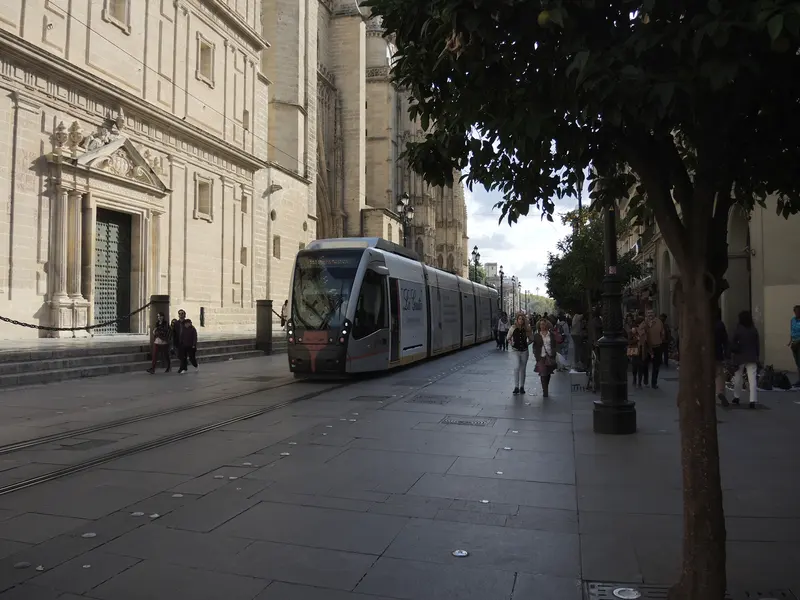
Seville's tram, the MetroCentro, is short but handy. It runs a single line along the central spine — broadly from near the cathedral on Avenida de la Constitución up toward the Plaza Nueva and on to the San Bernardo area — gliding quietly past some of the city's grandest frontages. It won't get you far, but it saves a hot walk along the main axis and is a small pleasure in itself. Buy a ticket before boarding from the platform machines, and validate as required.
The metro is similarly compact: a single line (Line 1) that arcs across the city from the western suburbs through the centre's southern edge and out to the east. It's fast and air-conditioned, which makes it a blessing in summer, but its route doesn't blanket the tourist core, so most visitors use it only for specific hops. For both tram and metro, check current fares and the reusable travel-card options with the operator — they shift over time, and a stored-value card can work out cheaper than single tickets if you ride often.
- MetroCentro tram: one short central line along the main avenue — a heat-saver more than a network.
- Metro Line 1: a single fast, air-conditioned line that skirts rather than covers the centre.
- Buy and validate tickets before boarding; ask about stored-value travel cards (verify fares).
Are city buses worth using?
Yes, for the places walking and the tram don't reach. Seville's urban bus network (run by TUSSAM) is extensive and inexpensive, with circular lines around the centre and routes fanning out to the neighbourhoods, and it's the natural way to reach somewhere like the Macarena, the outer reaches of Triana, or the airport (on the dedicated EA airport bus). Frequencies are decent on the main lines, and the buses are air-conditioned — no small thing in July.
The catch for short visits is simply learning the routes, which takes more effort than the obvious walking lines. A mapping app will plot a bus journey for you in seconds, which is the easiest way to use the network without memorising it. As ever, check current fares and whether a travel card makes sense for your trip; buy your ticket as instructed and keep a little change handy.
- TUSSAM city buses are cheap, air-conditioned and reach the outer neighbourhoods and the airport.
- The EA bus links the airport with the centre — handy if you'd rather not taxi.
- Use a maps app to plot routes rather than learning the network; verify fares.

When should I just take a taxi?
Whenever the heat, the hour or your luggage makes walking unappealing. Seville's taxis are licensed (white with a blue stripe), metered and regulated, and for a cross-city trip they're genuinely inexpensive — a quick way from Santa Justa station to your hotel, or home from a late dinner across the river. Fares run on a regulated tariff with set supplements rather than haggling, so insist on the meter, and check the official municipal rates if a fare ever feels wrong.
Ride-hailing apps also operate in the city and can be convenient for booking and payment, though availability varies. For most visitors the traditional taxi rank or a flagged cab is the simplest answer, especially for the airport run, an early train or the walk you really don't fancy doing at three in the afternoon in August.
- Official taxis are white with a blue stripe, metered and regulated — ask for the meter.
- Best for the station and airport runs, late nights, and the worst of the midday heat.
- Ride-hailing apps operate too, with variable availability; check current taxi tariffs.
Is Seville good for cycling?
Exceptionally. Seville reinvented itself as a cycling city, building one of Spain's most complete networks of segregated bike lanes across the flat, compact centre. There's a public bike-share scheme (Sevici) with docking stations dotted around town, designed for short point-to-point hops, plus plenty of shops and tour companies renting bikes by the hour or day. On the level ground, a bike is a fast, breezy way to cover the river, the parks and the wider neighbourhoods.
Two caveats. First, ride on the marked lanes where they exist rather than weaving through the densest pedestrian lanes of Santa Cruz, where walking is simply better. Second, the same summer heat that punishes walkers punishes cyclists — early morning and evening are the kind hours. For a guided introduction, a bike tour is a lovely way to learn the layout before you strike out alone.
- Extensive segregated bike lanes across a flat, compact centre — among Spain's best.
- Sevici public bike-share for short hops, plus rental shops and guided tours.
- Use the lanes, skip the tightest old-town alleys, and ride in the cool of morning or evening.
How do the heat and cobblestones change things?
More than any timetable. From roughly June to September, Seville is one of the hottest big cities in Europe, with summer highs that make midday movement genuinely draining. The local rhythm answers this: do your walking and sightseeing in the cooler morning, rest or take air-conditioned transport through the worst of the afternoon, and re-emerge for the evening. Carry water, plan shaded routes, and don't be proud about taking a tram or taxi when the sun is at its fiercest.
Underfoot, the old town's beauty comes with uneven cobbles, marble paving polished slippery in places and the odd kerb-less lane shared with the tram. Comfortable, sturdy shoes beat sandals or heels here, and travellers with wheeled luggage, prams or limited mobility should expect a bumpy ride on the historic streets — another reason a short taxi sometimes beats a long walk. None of it is a real obstacle; it just rewards a little planning around the time of day and the surface under your feet.
- Summer is fierce — walk and sightsee in the morning, ride or rest in the afternoon heat.
- Carry water, seek shade, and don't hesitate to take air-conditioned transport midday.
- Cobbles and polished marble call for sturdy shoes; wheels and prams find the old streets bumpy.
Seville Public Transport Guide
Buses, the tram, the single metro line, the airport bus and taxis explained — how Seville's transport fits together, when each is worth it, and the honest truth that in the old centre you'll mostly just walk.
Read guide
Self-Guided Old Town Seville Walk
A walkable, self-guided loop through Seville's old town: from the Cathedral and Giralda along the Alcázar walls into Santa Cruz, out to the Arenal and river, then up through Centro to El Salvador, the Setas and tapas.
Read guide
Seville Bike Tours Guide
Seville is one of Europe's best cities to cycle: flat, compact and laced with segregated bike lanes. A guide to the best areas to ride, the kinds of bike tour on offer, the heat and family considerations, and when a bike beats walking.
Read guideMore in Travel Tips
6
Accessible Seville Travel Guide
A realistic, affectionate guide to seeing Seville with limited mobility, a wheelchair or a slower pace — which monuments roll well, where the cobbles bite, how the taxis and tram help, and how to build heat breaks into a day so the city stays a pleasure rather than a battle.
Read guide
Best Time to Visit Seville
When to come to Seville, season by season — orange-blossom spring and its great festivals, the fierce but manageable summer, golden autumn culture and quiet, well-priced winter — so you can match the city's mood to your own.
Read guide
Is Seville Safe?
Practical, honest safety advice for Seville: how the city feels day and night, pickpockets and petty theft in crowds, the very real danger of summer heat, nightlife, solo travellers and the special case of festival days.
Read guide
Luggage Storage in Seville
Where to drop your bags in Seville on an awkward in-between day — beside Santa Justa station, around the central sights, before a tour or after check-out — so you can spend your last hours wandering the orange-tree lanes instead of dragging a suitcase over cobbles.
Read guide
Money & Tipping in Seville
How money actually works in Seville: when cards sail through and when you'll want coins, how light and optional tipping really is, the etiquette of paying at a tapas bar, and the small cash realities — markets, taxis, toilets — that catch visitors out.
Read guide
Seville Airport to City Center
The easiest ways from Seville Airport (SVQ) into the city — the airport bus, a fixed-tariff taxi, a pre-booked private transfer or a rental car — with honest notes on cost, comfort and which suits whom.
Read guide