
Seville Santa Justa Station Guide
How to use Seville's main railway station, Santa Justa: arrivals, the AVE high-speed line to Madrid and Córdoba, regional trains to Cádiz and Jerez, taxis, the metro and tram, luggage storage and how to reach the old town.
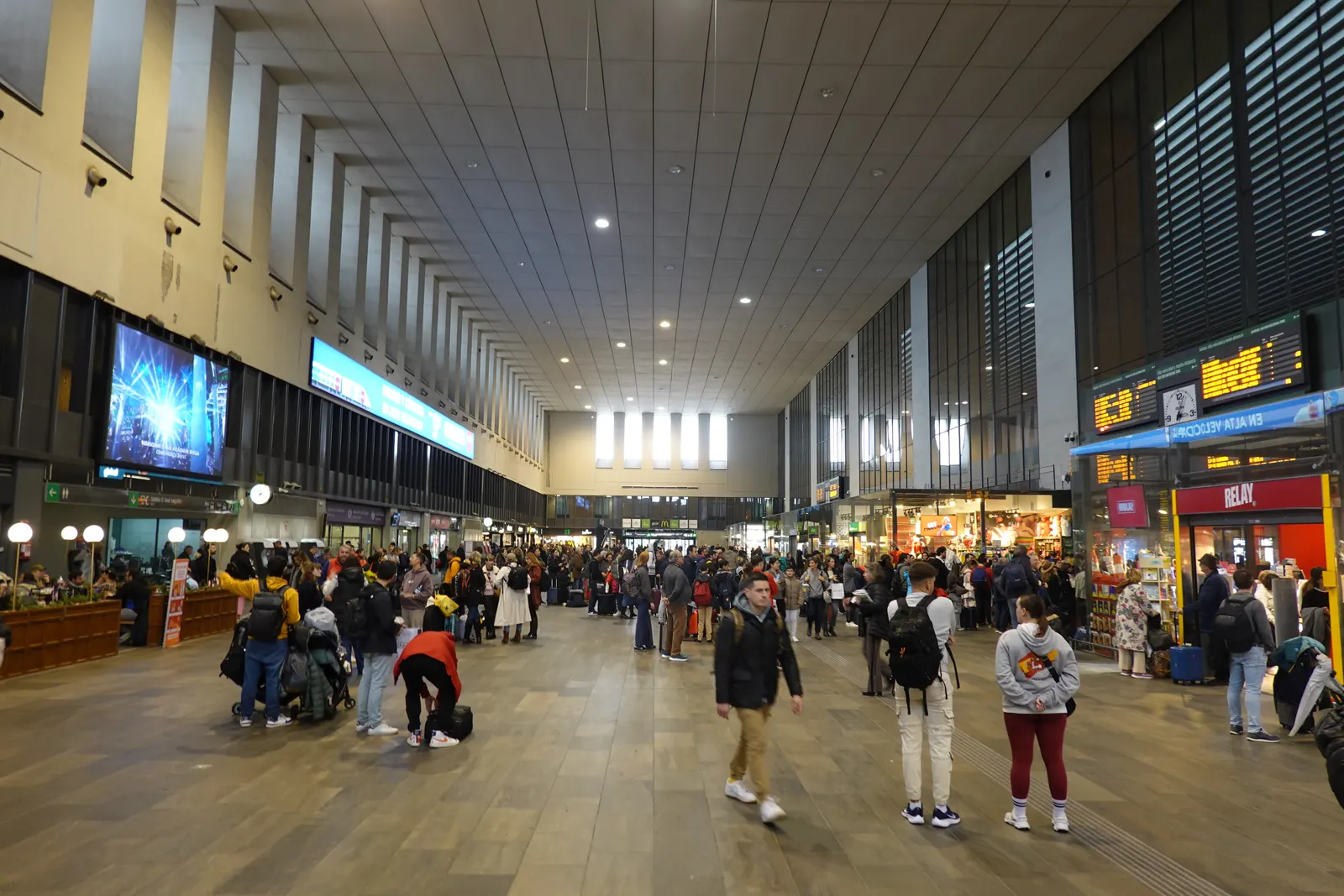
Photo: Smiley.toerist / Wikimedia Commons · CC BY-SA 4.0
- ✓Santa Justa is Seville's only mainline station — the gateway for nearly every train into and out of the city.
- ✓It anchors the high-speed AVE corridor: Córdoba in around three-quarters of an hour and Madrid in well under three hours.
- ✓Regional and Media Distancia trains run south to Cádiz and Jerez and west toward Huelva, making it the launchpad for rail day trips.
- ✓There's a taxi rank, a bus stop on the doorstep and the C1/C2 tram-and-metro links onward; the old-town cathedral is roughly a 20–30 minute walk.
- ✓Allow buffer time for security and platform checks, and always verify timetables and fares with the operator before you travel.
One station, almost every train
For all its tangle of medieval lanes, Seville keeps its railways admirably simple: there is essentially one station, and you will use it. Estación de Sevilla Santa Justa sits in the modern Nervión district, a little east of the historic core, and it is the single point through which nearly every long-distance and regional train arrives and departs. There is no confusing scatter of termini to learn, no wrong-station anxiety — if you are catching a train in Seville, you are almost certainly catching it here.
The building itself is a confident piece of late-1980s architecture, opened ahead of the 1992 Expo and the arrival of Spain's first high-speed line. Under its long, ribbed vault you'll find the usual machinery of a modern station: ranks of departure boards, ticket counters and self-service machines, a clutch of cafés and shops, car-hire desks and the gateways down to the platforms. It is bright, orderly and easy to read, which makes both a bleary-eyed early departure and a hot-afternoon arrival far less daunting than they might be.
Where the trains go
Santa Justa's headline act is the AVE high-speed line. These sleek long-distance trains connect Seville to Córdoba in roughly three-quarters of an hour and run on to Madrid in well under three hours, with onward links across the network. For day-trippers, the Córdoba hop is a gift: you can be standing in front of the Mezquita-Catedral before mid-morning. Alongside the state operator's AVE services, other high-speed brands now share the corridor, so it's worth comparing options for the Madrid run.
Closer to home, the regional and Media Distancia services are what turn Seville into the best rail base in Andalusia. Frequent trains head south toward Jerez and Cádiz, giving you the sherry country and an Atlantic seafront within easy reach, and others run west toward Huelva. These are slower, simpler trains than the AVE, but they open up a string of day trips that need nothing more than a return ticket and an early start.
Because timetables, fares and even the mix of operators change from season to season, treat any specific journey time as a guide rather than a guarantee. Check current schedules and prices directly with the operators when you plan, and book the popular high-speed runs ahead in busy periods, when the best fares and seats go early.
- High-speed AVE: Córdoba in ~45 minutes; Madrid in under 3 hours (verify).
- Regional / Media Distancia: south to Jerez and Cádiz, west toward Huelva.
- Several operators now share the high-speed corridor — compare before booking.
- Book ahead at peak times for the best fares; always verify times with the operator.
Arriving: getting from platform to old town
Step off the train and your goal is usually the historic centre, around two and a half kilometres west. The most reliable option is the taxi rank directly outside the main entrance: licensed white cabs with a blue stripe, metered, and quick to the cathedral in normal traffic. As a rough discipline, agree you'll go by the meter and check the official municipal tariff if anything seems off — fares are regulated, and there are set supplements (for luggage or certain times) rather than open negotiation.
If you'd rather not take a cab, city buses stop near the station and run into the centre, and the single metro line plus the tram network connect Nervión onward toward the old town's edge. None of it is complicated, but with a heavy case in summer heat the taxi is often worth the few euros. The walk into the centre is perfectly pleasant in cool weather — roughly twenty to thirty minutes through the modern district — and a fine first stroll if you've travelled light.
- Taxi rank at the main entrance — metered, regulated fares; cathedral in minutes by car.
- City buses and the metro/tram link the station onward into the centre.
- Walk to the old town is roughly 20–30 minutes — easy in cool weather, hard in summer with luggage.
Luggage, services and the small print
Santa Justa is well set up for the practicalities. There's left-luggage storage at the station for the gap between an early checkout and a late train, car-hire desks if you're picking up wheels for the white villages, cafés and food outlets for a coffee or a quick bite before departure, and the usual cash machines and shops. Locker availability and prices vary, so confirm on the day rather than counting on a free space, especially during festivals and peak summer.
A few habits make departures smooth. Arrive with a comfortable buffer: long-distance trains can involve a baggage and ticket check before you reach the platform, and the gate to a given track is shown on the boards only shortly before departure, so keep an eye on them. Have your ticket — paper or on your phone — ready, mind your bags in the busy concourse as you would in any large station, and you'll find Santa Justa one of the easier big-city stations in Spain to pass through.
- Left-luggage storage on site (confirm availability and price on the day — verify).
- Car-hire desks, cafés, shops and cash machines in the concourse.
- Arrive early: long-distance trains may have a baggage/ticket check before the platform.
- Platforms are posted shortly before departure — watch the boards.
Map pins
Map data © OpenStreetMap contributors · Tiles © OpenFreeMap
At a glance
Santa Justa is the one station you need to know in Seville, and it does its job with unfussy efficiency. Build in a little buffer, keep an eye on the boards, and treat it as the start of the trip — because more often than not, the moment you step out of it, Andalusia opens up in every direction.
- Name: Estación de Sevilla Santa Justa, in the Nervión district, east of the old town.
- Role: Seville's only mainline station — AVE high-speed plus regional services.
- Reach Córdoba in ~45 min, Madrid in under 3 hr, Cádiz and Jerez to the south (verify times).
- From the station: taxi rank at the door, plus bus, metro and tram into the centre.
- Cathedral / old town: roughly 20–30 minutes on foot, two and a half kilometres west.
- On site: left luggage, car hire, cafés, shops, cash machines (confirm details on the day).

Nervión & Santa Justa Guide
Seville's modern eastern district built around Santa Justa station: business hotels, big shopping, football at the Sánchez-Pizjuán, and the convenience-versus-charm trade-off against staying in the Old Town.
Read guide
Best Day Trips from Seville
Seville is the best base in Andalusia for day trips — Córdoba's mosque-cathedral, Cádiz on the Atlantic, Ronda's gorge, Jerez sherry, the Roman ruins of Itálica and the white villages — compared by travel time, effort, season and who each one suits.
Read guide
Luggage Storage in Seville
Where to drop your bags in Seville on an awkward in-between day — beside Santa Justa station, around the central sights, before a tour or after check-out — so you can spend your last hours wandering the orange-tree lanes instead of dragging a suitcase over cobbles.
Read guideMore in Travel Tips
6
Accessible Seville Travel Guide
A realistic, affectionate guide to seeing Seville with limited mobility, a wheelchair or a slower pace — which monuments roll well, where the cobbles bite, how the taxis and tram help, and how to build heat breaks into a day so the city stays a pleasure rather than a battle.
Read guide
Best Time to Visit Seville
When to come to Seville, season by season — orange-blossom spring and its great festivals, the fierce but manageable summer, golden autumn culture and quiet, well-priced winter — so you can match the city's mood to your own.
Read guide
Getting Around Seville
When to walk, take a taxi, hop the tram, ride the metro or a city bus, and when to cycle in Seville — with honest notes on the summer heat, the cobblestones and how compact the centre really is.
Read guide
Is Seville Safe?
Practical, honest safety advice for Seville: how the city feels day and night, pickpockets and petty theft in crowds, the very real danger of summer heat, nightlife, solo travellers and the special case of festival days.
Read guide
Money & Tipping in Seville
How money actually works in Seville: when cards sail through and when you'll want coins, how light and optional tipping really is, the etiquette of paying at a tapas bar, and the small cash realities — markets, taxis, toilets — that catch visitors out.
Read guide
Seville Airport to City Center
The easiest ways from Seville Airport (SVQ) into the city — the airport bus, a fixed-tariff taxi, a pre-booked private transfer or a rental car — with honest notes on cost, comfort and which suits whom.
Read guide