
Nervión & Santa Justa Guide
Seville's modern eastern district built around Santa Justa station: business hotels, big shopping, football at the Sánchez-Pizjuán, and the convenience-versus-charm trade-off against staying in the Old Town.

Photo: Santiago Lacarta / Unsplash
- ✓Nervión is the modern commercial district east of the old town, built around Santa Justa — Seville's main railway station.
- ✓It's the most convenient base for train travellers: high-speed AVE services to Córdoba, Madrid and beyond leave from your doorstep.
- ✓Reliable business and chain hotels, big shopping (the Nervión Plaza centre) and easy parking make it practical and good value.
- ✓It's home to the Ramón Sánchez-Pizjuán, Sevilla FC's stadium — a draw on match days.
- ✓The trade-off is atmosphere: it's a workaday modern district, a 20–30 minute walk or short tram/metro hop from the historic core.
The modern, working side of Seville
East of the old walled city, Seville changes character. The lanes and orange trees give way to Nervión: a 20th-century district of wide avenues, office blocks, apartment towers, shopping centres and the city's main train station. There's no Mudéjar palace or tiled patio here — this is contemporary, commercial Seville, the part of the city that goes to work, shops at the mall and catches the train. For most leisure travellers it's somewhere to pass through; for some, it's a deliberately practical place to stay.
The anchor is Santa Justa station, the gateway through which most rail visitors arrive. Around it has grown a cluster of business and chain hotels, restaurants geared to commuters and travellers, and the big-box convenience the old town can't offer. The appeal is entirely functional: reliability, value, transport links and ease, rather than charm. Knowing when those things outweigh the romance of a central base is the whole point of this guide.
Santa Justa: the transport advantage
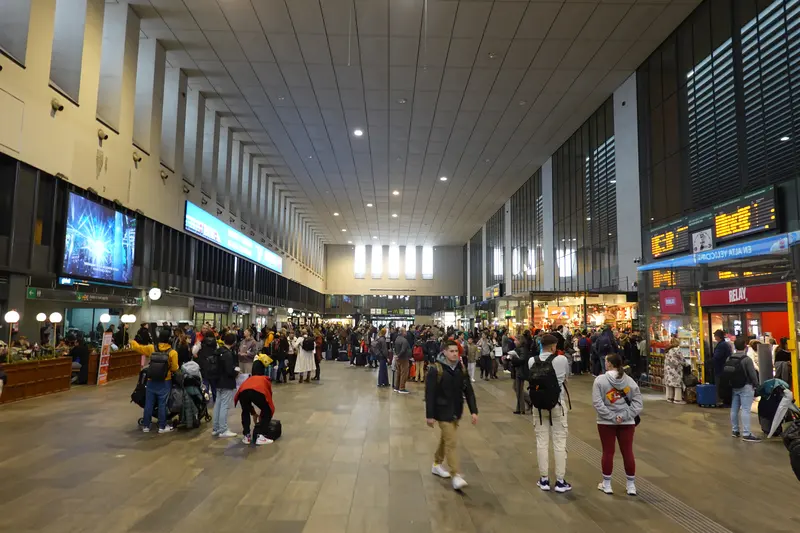
Santa Justa is Seville's principal railway station and the single strongest reason to consider this area. It's the terminus for the high-speed AVE line — fast, comfortable trains to Córdoba in around three-quarters of an hour and on to Madrid in well under three hours — as well as regional services across Andalusia toward Cádiz, Jerez, Huelva and beyond. If your trip is built around day trips by train, or you're arriving and leaving by rail, staying within a few minutes' walk of the platforms is a real, tangible convenience.
That makes Nervión a logical base for travellers who'll be in and out of the station: anyone planning multiple Andalusian day trips, those with early departures or late arrivals who don't want a cross-city dash with luggage, and business visitors. The metro and tram, plus city buses, connect the station onward into the centre, so you're not stranded out east. Check current train timetables and fares directly with the operators, as schedules and prices change.
Santa Justa is a modern, well-equipped station, with the usual luggage lockers, car-hire desks, cafés and a taxi rank, so it works smoothly as an arrival and departure point. If your itinerary strings together several Andalusian cities by rail — Córdoba one day, Cádiz or Jerez another — there's a real, practical logic to sleeping a few minutes from the platforms rather than hauling bags across the old town each morning. For a slower, single-city Seville trip, that advantage simply doesn't apply, which is why the area suits some travellers far better than others.
- Santa Justa is the hub for high-speed AVE trains (Córdoba ~45 min; Madrid under 3 hr) and regional services.
- Ideal for rail-based day trips, early departures and late arrivals.
- Metro, tram and buses link the station onward into the old town.
- Verify timetables and fares with the operators before relying on a connection.
Hotels: reliable and good value
Nervión's accommodation is its other selling point. This is where you'll find the city's concentration of dependable international chain and business hotels — full-service properties with consistent standards, lifts, parking, on-site restaurants and the kind of room sizes the old town's converted historic buildings can't always match. For travellers who prize predictability, accessibility or the ability to drive in and park, that matters.
It also tends to be better value than the heart of the old town, and it holds up well at busy times when central prices spike. Drivers in particular benefit: parking is far easier out here than in the medieval core, where many streets are restricted and garages are scarce and pricey. The catch, again, is location — you're choosing comfort and convenience over the experience of stepping out of your door into historic Seville.
- A cluster of reliable chain and business hotels with full facilities and parking.
- Generally better value than the old town, and steadier at peak times.
- Much easier for drivers — parking is simpler than in the restricted historic centre.

Shopping and the stadium
Nervión is also Seville's mainstream shopping district. The Nervión Plaza centre and the surrounding avenues gather department stores, high-street fashion, electronics, a cinema and chain dining under one roof and along the main streets — handy if you need to actually buy something rather than browse boutiques, or if rain or fierce heat makes an air-conditioned mall genuinely appealing. It's everyday retail rather than the artisan ceramics and fans of the old town, but it has its uses.
The district is also home to the Estadio Ramón Sánchez-Pizjuán, the stadium of Sevilla FC. On match days the area takes on a real buzz, with fans, bars and a charged atmosphere; for football-minded visitors, staying nearby puts you in the thick of it. Outside of match days it's quieter, but the stadium remains a local landmark and an option for a tour if the club runs them — check directly for availability.
- The Nervión Plaza centre and surrounding streets are Seville's main mainstream shopping zone.
- A useful air-conditioned refuge in heat or rain.
- Home to the Ramón Sánchez-Pizjuán, Sevilla FC's stadium — lively on match days.
Map pins
Map data © OpenStreetMap contributors · Tiles © OpenFreeMap
Eating in Nervión
Nervión won't feature on anyone's classic tapas crawl, but it eats perfectly well in an everyday, local way. Because the district serves office workers, shoppers and residents rather than tourists, you'll find honest neighbourhood bars and restaurants, set-price lunch menús del día aimed at the working crowd, and the usual chains and casual spots clustered around the shopping centre and the station. Prices are pitched at locals, and the menú del día — a fixed multi-course lunch — is excellent value if you eat your main meal in the middle of the day, as Seville does.
What you won't get here is the atmosphere of an old-town tapas evening: the tiled bars, the standing crowds, the bar-to-bar wander. For that you'll head into the centre or across to Triana. Around the stadium, match days bring a surge of busy fan bars; the rest of the time the dining scene is functional and friendly rather than memorable. Treat Nervión as somewhere to eat conveniently and cheaply, and save the showpiece meals for the historic neighbourhoods.
- Honest local bars, casual chains and great-value menú del día lunches aimed at workers and residents.
- No old-town tapas atmosphere — head into the centre or Triana for that.
- Lively fan bars around the stadium on match days.

Getting to the old town
The honest weakness of a Nervión base is the walk to the sights. The cathedral, the Alcázar and Santa Cruz are roughly a 20–30 minute walk away — perfectly doable in cool weather, less appealing in the summer heat or with tired feet. Fortunately the connections are good: the city's single metro line runs to the edge of the centre, the tram threads into the historic core, and frequent buses and inexpensive taxis fill the gaps. You won't feel cut off, but you will be commuting to the monuments rather than living among them.
That's the crux of the decision. In a compact, intensely walkable old city, staying outside it means trading the daily pleasure of strolling out into history for a short ride or a longer walk each time. For a sightseeing-led trip, that friction adds up; for a transport-led or value-led trip, it's a price worth paying.
- Cathedral and old town are roughly a 20–30 minute walk.
- Metro, tram, buses and cheap taxis make the hop easy.
- You'll commute to the sights rather than step straight into them.
Who should stay in Nervión — and who shouldn't
Nervión and Santa Justa are right for a clearly defined traveller. Choose this base if your trip leans on the train — multiple Andalusian day trips, an early or late rail connection — if you're driving and need easy parking, if you want a reliable full-service or business hotel, or if you're chasing value and don't mind a short ride into the centre. Football fans and pragmatic, convenience-first travellers also do well here.
Skip it if this is a first, short, romance- or sightseeing-led visit. Seville's whole magic lies in its old town, and on a brief trip you'll want to be inside it — waking up to the Giralda, wandering Santa Cruz after dark, soaking in the atmosphere that Nervión simply doesn't have. For that, a central neighbourhood like Santa Cruz, El Arenal or Centro is worth the extra cost. As always, weigh exactly what your trip is for, and confirm hotel distances and transport links before you book.
- Stay here for: train-led trips, drivers, business stays, reliable chains, value.
- Stay elsewhere for: a first, short, romantic or sightseeing-focused visit.
- The trade is always the same — convenience and value versus old-town atmosphere.
Seville Santa Justa Station Guide
How to use Seville's main railway station, Santa Justa: arrivals, the AVE high-speed line to Madrid and Córdoba, regional trains to Cádiz and Jerez, taxis, the metro and tram, luggage storage and how to reach the old town.
Read guide
Best Day Trips from Seville
Seville is the best base in Andalusia for day trips — Córdoba's mosque-cathedral, Cádiz on the Atlantic, Ronda's gorge, Jerez sherry, the Roman ruins of Itálica and the white villages — compared by travel time, effort, season and who each one suits.
Read guide
Best Budget Hotels in Seville
Where to save on a Seville hotel without losing too much time, shade or transport convenience: which neighbourhoods give the best value, when budget rooms make sense, and the trade-offs to watch in the hot months and festival weeks.
Read guideMore in Where to Stay
6
Alameda de Hércules Guide
Seville's most easygoing, creative quarter: the long tree-lined Alameda boulevard, its bars, cafés and live-music nights, brunch culture, apartments and bohemian energy — and who should choose it as a base.
Read guide
Alfalfa & Encarnación Guide
Alfalfa and Encarnación are the old town's tapas-and-nightlife engine: a dense pocket of bars and plazas under the Setas, full of central apartments and walk-home-after-dinner energy.
Read guide
Barrio Santa Cruz Guide
Stay, walk, eat and sightsee in Barrio Santa Cruz — Seville's atmospheric old Jewish quarter, wrapped tight around the cathedral and the Alcázar, all whitewashed lanes, tiled patios and orange trees.
Read guide
Best Area to Stay in Seville First Time
The simplest hotel-area decision guide for a first Seville visit: where to base yourself for the icons, the tapas and the evening paseo, and how to choose between Santa Cruz, El Arenal, Centro and Alfalfa without overthinking it.
Read guide
Best Boutique Hotels in Seville
A guide to Seville's smaller, stylish hotels — the patio houses, rooftop-pool conversions and design-led stays with real neighbourhood character — including which areas suit which mood, the trade-offs of historic buildings, and what to confirm before you book.
Read guide
Best Family Hotels in Seville
How to choose a family base in Seville — the areas that suit children, why a pool and air conditioning matter so much in summer, the room types that fit a family, the stroller-versus-cobbles trade-off, and the heat-aware logic that keeps everyone happy.
Read guide