
Semana Santa in Seville Guide
How to experience Seville's Holy Week with understanding and respect: what the processions are, where they pass, the great floats and brotherhoods, the all-night Madrugá, the crowds and street closures, what to wear and how to behave, where to stay, and how to plan a complex week calmly.

Photo: Pille R. Priske / Unsplash
- ✓Semana Santa (Holy Week) runs the week before Easter Sunday. Because Easter moves, so do the dates — confirm the exact days for your year before booking anything.
- ✓It is a solemn religious festival, not a celebration: brotherhoods carry venerated images in candlelit processions, and the mood is one of reverence. Dress and behave respectfully.
- ✓The emotional peak is the Madrugá — the long night of Holy Thursday into Good Friday — when the most beloved brotherhoods process before vast crowds through the small hours.
- ✓Processions and crowds reshape the centre: streets close, routes fill, and ordinary sightseeing bends around the week. Pick up a procession schedule and plan your movements.
- ✓Hotels fill and prices climb months ahead. Book early, choose a base with care, and build patience into every plan.
What Semana Santa is
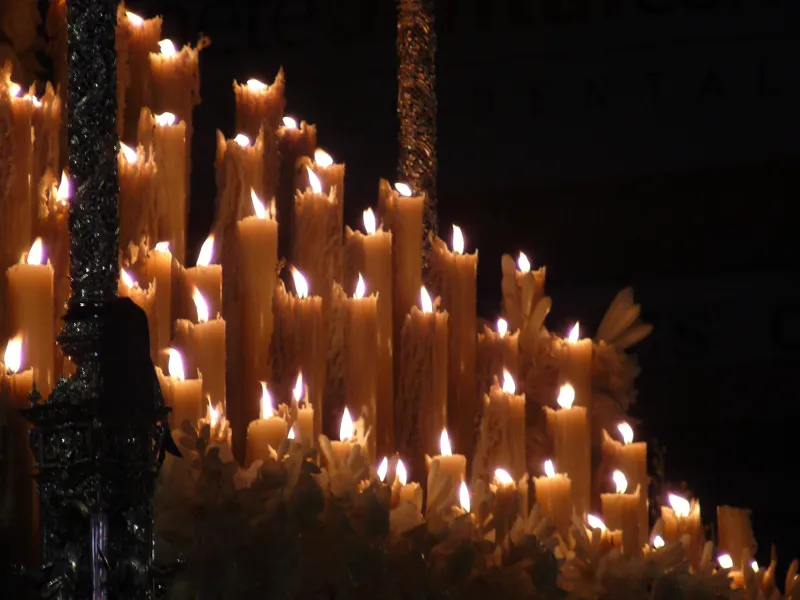
Semana Santa — Holy Week — is the most powerful and moving thing you can witness in Seville, and for many visitors the most unforgettable. Across the week before Easter, dozens of religious brotherhoods (called hermandades or cofradías) carry their venerated images out of their home churches and process slowly through the city to the Cathedral and back. These images — sculptures of Christ in his Passion and of the grieving Virgin (the Dolorosa), some of them centuries old and of extraordinary devotional and artistic value — are mounted on great floats called pasos, lit by banks of candles, dressed in flowers and, in the case of the Virgins, in embroidered velvet canopies and silver.
Each brotherhood's procession is a long, ordered column: ranks of robed, hooded penitents called nazarenos (the pointed hoods, the capirote, are an ancient symbol of penance and predate any modern association), candle-bearers, brass and drum bands, and the pasos themselves, borne unseen on the shoulders and necks of hidden bearers called costaleros who move the immense weight in a swaying, rhythmic walk. The processions can last many hours and run deep into the night. What you are watching is not a show but an act of collective devotion that the city has performed for centuries — and its emotional force, even for the non-religious, is hard to overstate.
When it happens — and why the dates move
Semana Santa always runs from Palm Sunday (Domingo de Ramos) through to Easter Sunday (Domingo de Resurrección), but because Easter is a moveable feast tied to the lunar calendar, the whole week shifts from year to year. It can fall anywhere from late March to late April. This is the first and most important fact of planning: never assume a date. Look up the exact days for your travel year before you book, and bear in mind that processions run through all the days of the week, building toward the climactic days at the end.
Different days carry different brotherhoods and different intensities. The earlier days (from Palm Sunday) ease you in; the great days are Holy Thursday and Good Friday, and above all the Madrugá, the night that joins them. The full, official procession schedule for each year — which brotherhood processes when, and along what route — is published by the city and the Council of Brotherhoods closer to the event, and it is the single most useful document you can carry. Pick one up locally or consult the official source once it is released, and verify timings as you go, because processions can run late or, in bad weather, be cancelled at short notice.
- Runs Palm Sunday to Easter Sunday — the week before Easter, moving between late March and late April by year.
- Processions run every day, building to Holy Thursday, Good Friday and the Madrugá night between them.
- The official year-specific procession schedule is published closer to the event — carry it and verify timings.
- Rain can cancel a procession at short notice, as the images are too precious to expose to weather.
The Madrugá and the great days
The emotional summit of the entire week is the Madrugá — the long night of Holy Thursday into the early hours of Good Friday. Through these hours, some of the city's most beloved and historic brotherhoods make their way to the Cathedral, among them images so adored that they have their own near-mythic place in Sevillano hearts. The streets fill with enormous, hushed crowds who wait, sometimes for hours, to see a particular paso pass. It is exhausting, overwhelming and unlike anything else — and for many it is the reason they came.
If you intend to experience the Madrugá, go in with a plan and realistic expectations. The crowds are immense, the night is long, and you will not see everything; pick one or two images you most want to witness, find out roughly where and when they pass, and accept a great deal of waiting. Bring water, wear comfortable shoes, and prepare for a night that may run until dawn. Good Friday itself continues with solemn morning and evening processions, and the week resolves on Easter Sunday. The earlier days, by contrast, are gentler and far easier for a first-timer to absorb — a good way to learn the rhythms before the great nights.
- The Madrugá (Holy Thursday into Good Friday) is the emotional peak, with the most beloved brotherhoods.
- Expect vast crowds and long waits; choose one or two pasos to see rather than trying to see everything.
- It is an all-night event — bring water, wear good shoes, and prepare to be out until dawn.
- The earlier days are calmer and a gentler introduction for first-time visitors.
Where the processions pass, and street closures
Every brotherhood follows its own route from its home church, but all of them converge on a single official stretch — the carrera oficial — that runs through the centre to the Cathedral. This means the heart of the city, around the Cathedral, the Avenida de la Constitución and the surrounding streets, is the busiest and most processional zone, with grandstand seating (paid, and reserved well ahead) lining parts of the route. Away from the carrera oficial, you can often find a quieter spot to watch a brotherhood as it sets out from its own neighbourhood church, which many regulars consider the more intimate and beautiful way to see a procession.
The practical consequence is that the centre's geography reorganises itself for the week. Streets along procession routes close to traffic and fill with crowds; crossing the path of a procession can be impossible for long stretches, so a walk that normally takes ten minutes may take an hour or be barred entirely. The golden rule is to know which processions are out and where, so you can position yourself ahead of time and avoid being trapped on the wrong side of a passing column. Move early, build in generous time, and never assume you can cut across the centre quickly during procession hours.
- All brotherhoods converge on the carrera oficial, the official route through the centre to the Cathedral.
- Paid grandstand seats line parts of the route and are reserved well in advance — verify availability locally.
- Watching a brotherhood leave its own neighbourhood church can be quieter and more moving than the crush at the centre.
- Street closures make crossing the centre slow or impossible during procession hours — plan routes and timings around them.
Etiquette, dress and behaviour
This is the part visitors most need to hear, because Semana Santa is a religious observance and the city is sensitive to how it is treated. The prevailing mood near a procession is reverent silence and stillness. When a paso passes, especially a Virgin, crowds fall quiet; sometimes a singer will deliver a saeta, an unaccompanied flamenco lament from a balcony, and the whole street stops to listen. Do not talk loudly, do not push to the front, do not block the route or the bearers, and never treat the processions as a backdrop for boisterous behaviour. Photography is generally fine but should be discreet and never intrusive — no flash in someone's face, no climbing for a shot, no stepping into the path of the procession.
On dress: there is no strict code for spectators, but err toward modest, respectful clothing, particularly if you enter churches, and lean a little smarter than ordinary sightseeing wear — many Sevillanos dress up for the week. Crucially, do not attempt to dress in anything resembling the nazareno robes or hoods; they are sacred to the brotherhoods and never a costume. Show the same courtesy you would in any place of worship, follow the lead of the locals around you, and you will be a welcome, respectful witness to something profound rather than an intruder upon it.
- Keep quiet and still when a paso passes, especially a Virgin; a saeta may be sung and the street will hush.
- Do not block routes, push, or treat the processions as a party backdrop — this is an act of devotion.
- Photograph discreetly, without flash in faces or stepping into the procession's path.
- Dress modestly and a little smartly; never imitate the nazareno robes or hoods.

Where to stay and how to eat during the week
Accommodation is the single biggest planning challenge of a Semana Santa trip. The city fills and prices rise sharply, often months in advance, so book as early as you can. The trade-off in choosing a base is between being in the heart of the action and being able to escape it: a hotel right on or beside the carrera oficial puts the processions on your doorstep but can mean noise, crowds and difficulty coming and going at all hours, while a base a little outside the procession core gives you a calmer retreat and easier movement, at the cost of a longer walk in. There is no wrong answer — decide whether you want to be immersed or to dip in and out — but whichever you choose, book it long before you would for an ordinary trip.
Eating and drinking also shift for the week. Bars and restaurants near procession routes are heaving, and getting a table or even reaching a favourite place can be hard when streets are closed. Plan to eat at off-peak hours, be willing to wander away from the procession zone to find space, and consider stocking water and snacks for the long waits, especially on the Madrugá. Many places do a brisk, standing trade in the gaps between processions; embrace that rhythm rather than expecting a leisurely sit-down meal in the centre during peak hours.
- Book accommodation months ahead — Semana Santa sells the city out and lifts prices steeply.
- Choose between a base in the procession heart (immersive but busy) or just outside it (calmer, easier to move).
- Bars near routes are packed and streets are closed; eat at off-peak hours or away from the procession zone.
- Carry water and snacks for long waits, especially through the Madrugá.
Sightseeing, accessibility and a calm plan
Can you still see Seville's monuments during Holy Week? Largely yes, but with caveats. The great sights generally keep their own opening arrangements, though some may adjust hours for the religious calendar, so verify before you go. The bigger obstacle is simply moving through a centre reorganised around processions. The sane strategy is to do your monument visits in the morning, before the day's processions are fully underway, and to treat the afternoons and evenings as procession time. Book the Alcázar and Cathedral ahead as always, and accept that some days the processions will be the whole of your sightseeing — which is no loss at all.
For travellers with reduced mobility or anyone sensitive to dense crowds, Semana Santa demands honest planning. The crowds can be overwhelming, standing for hours is hard, and the closures make wheelchair routes unpredictable. Watching a brotherhood set out from a quieter neighbourhood church, rather than fighting the carrera oficial crush, is often far more manageable and more rewarding. Build rest into every day, keep expectations flexible, and remember that a single, well-chosen procession witnessed calmly is worth more than an exhausting attempt to see everything. Above all, come to Semana Santa for what it is — a profound, centuries-old expression of a city's faith — and meet it with patience and respect, and it will give you a memory like no other.
- Do monument visits in the morning, before processions fill the centre; book the Alcázar and Cathedral ahead.
- Verify any festival-week changes to opening hours before you go.
- For reduced mobility or crowd-sensitivity, watch a procession leave a quieter neighbourhood church rather than the central crush.
- Build in rest, stay flexible, and value one calm procession over an exhausting attempt to see it all.
Semana Santa Seville Itinerary
A route-and-crowd-aware plan for Holy Week in Seville: how the processions work, how to choose what to see without exhausting yourself, where to stand, and how to weave in meals, rest and ordinary sightseeing around the pasos.
Read guide
Seville in March
March in Seville means waking spring — mild, bright days, the first orange blossom, gardens reopening and, in some years, Semana Santa. A month-by-month guide to weather, crowds, festival timing and what to book before you come.
Read guide
Seville in April
April is peak spring in Seville — warm sun, orange blossom and, most years, the city's two great festivals: the tail of Semana Santa and the riot of Feria de Abril. A guide to the weather, the crowds, the festival logistics and exactly what to book first.
Read guideMore in Events
6
Bienal de Flamenco Guide
How to plan a trip around Seville's Bienal de Flamenco, the world's most important flamenco festival: when it runs, the kinds of shows and venues, how to find and book tickets, where to stay, and what to do if your trip falls in an off year.
Read guide
Christmas in Seville Guide
Christmas in Seville means lights along the old streets, nativity scenes (belenes), traditional markets like the one in Plaza de San Francisco, festive shopping, sweets and family events — all in cool, comfortable sightseeing weather. How to enjoy the season and plan around it.
Read guide
Corpus Christi in Seville
A guide to one of Seville's most beautiful and least touristy traditions: the Corpus Christi morning, when the centre is strewn with fragrant herbs and a stately procession winds from the Cathedral through streets dressed for the feast. When it falls, what to expect, where to watch, and how to plan around the early-summer crowds.
Read guide
Feria de Abril Guide
Everything a first-timer needs to understand Seville's April Fair: when it falls, what the fairground and the casetas are, the private-caseta system and how to get inside the fun, the daytime horse paseo and the lantern-lit nights, what to wear, what to eat and drink, where to stay, and how to fit the city around the fair.
Read guide
New Year's Eve in Seville
Nochevieja in Seville: the tradition of twelve grapes at midnight, where to gather, dinner timing, the late-night fiesta, taxis and getting home, and how to plan January 1. A practical guide to seeing in the year, Sevillano-style.
Read guide
Noche en Blanco Seville Guide
Seville's citywide cultural night, when museums, palaces, galleries and institutions open late and often free for one evening, usually in autumn. How it works, how to plan a route, what to reserve, and how to use it well.
Read guide